Vibe coding is suitable for marketplace apps, but only on platforms that generate genuine full-stack infrastructure. Marketplaces require multi-sided data models, payment splitting between parties, and search functionality at a level of complexity that frontend-only or prototype-focused tools were never built to handle. As of 2025–26, the full-stack tier of vibe coding platforms can handle marketplace fundamentals that were out of reach even a year or two ago, though the category is still maturing in the hardest edge cases. This article draws the line precisely: what a marketplace actually requires, where the ceiling currently sits, and how to tell whether a specific platform clears it.
Why is " marketplace " the test case that separates simple tools from real platforms
Ask any vibe coding platform whether it can build a marketplace, and the answer will almost always be yes. This is not a useful question because "marketplace" is used loosely enough to cover both a directory listing local plumbers and a two-sided platform processing split payments among thousands of independent sellers. These are not the same build, and treating them as interchangeable is exactly the category confusion this article exists to resolve.
Marketplace is a useful test case precisely because it sits at a specific complexity tier: harder than a standard CRUD application, but not as architecturally demanding as, say, a real-time collaborative editor. A tool that can genuinely handle a marketplace has crossed a threshold that a tool generating only simple internal apps has not. So "can it build a marketplace" is a reasonable proxy question for "how far up the complexity ladder does this platform actually reach," provided you're precise about which kind of marketplace you mean.
What a marketplace actually requires that a simple app doesn't
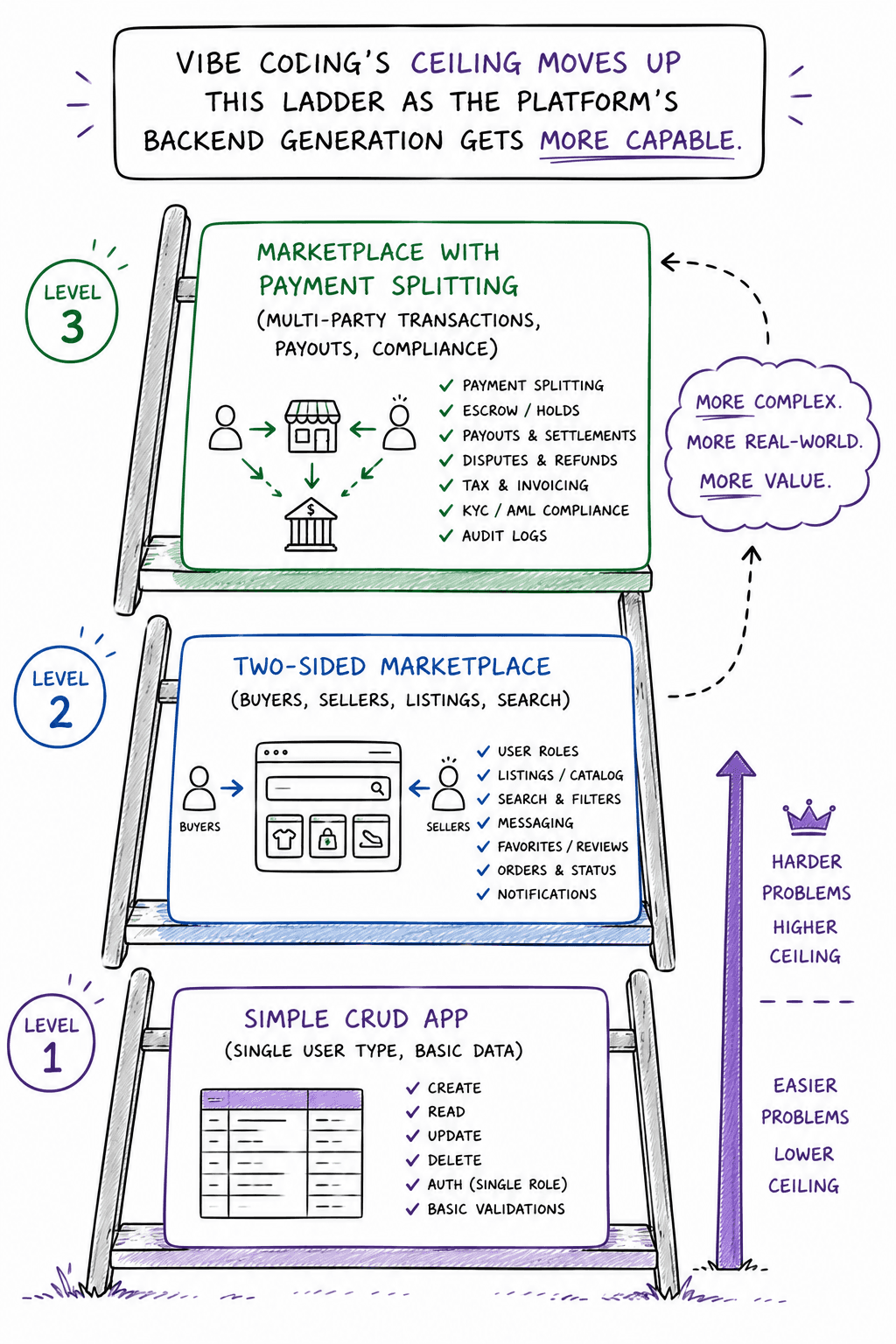
Worth separating three distinct tiers, because conflating them is where most confusion about feasibility comes from.
A simple CRUD application has one user type interacting with one set of data — create, read, update, delete. A task manager. A client portal. A booking calendar. The data model is straightforward: one table for users, a few related tables for records, and permissions that are mostly binary (you can see your own data, or you're an admin who sees everyone's).
A two-sided marketplace has at least two distinct user types with different permissions and different data needs — buyers and sellers, hosts and guests, tutors and students. The data model now has to represent relationships between these two sides: listings that belong to sellers, bookings that connect buyers to listings, and reviews that reference both parties. Search and filtering become genuinely necessary, not optional, because buyers need to find relevant listings among many options. This is meaningfully harder than a single-user-type CRUD app, but it's still within reach of a well-built backend generator, because the patterns — listings, bookings, reviews, two permission tiers — are common enough that AI systems have seen thousands of variations.
A marketplace with payment splitting adds a layer that most non-technical founders underestimate: money now needs to move correctly among three or more parties (buyer, seller, platform) on every transaction, with the platform's cut calculated and automatically withheld, and the seller's payout scheduled and tracked. This isn't just "add a payment button." It requires an architecture that can onboard sellers as connected accounts, verify their identities for compliance, and route funds accurately across potentially thousands of transactions without a human checking each one. This kind of infrastructure needs to onboard and verify sellers using connected accounts, manage payment routing to those accounts, and handle payout timing and destination accounts. That is a materially different engineering problem than storing a booking record. Stripe
Where frontend-only vibe coding tools hit their ceiling
This is where the taxonomy question becomes practical rather than academic.
A frontend-only tool — one that generates a polished interface connected to a simulated or externally managed backend — can produce something that looks like a marketplace in a demo. It can show listings, a browse page, and a booking flow. What it typically cannot do reliably is the part that makes a marketplace actually function as a marketplace: a real multi-sided data model with correctly enforced permissions, search that scales past a handful of test listings, and — critically — real money movement between multiple parties.
The payment layer is where frontend-only tools hit their ceiling hardest. Marketplace payment processing needs to orchestrate money correctly across every transaction, seller, and location a platform operates in — a buyer pays, a seller gets their share, the platform takes its cut, and all of this has to reconcile. A tool that generates a checkout button connected to a single merchant account is not equipped for this. It's solving a different, simpler problem — one-directional payment collection — and dressing it up as marketplace functionality. No7 Software
The honest read: frontend-only tools are not "bad" — they're built for a different job. They're well-suited to single-sided applications with straightforward data models. Asking them to generate marketplace infrastructure is asking them to do something outside their design, and the failure usually isn't visible until real sellers try to get paid.
What full-stack platforms can realistically handle today
Full-stack platforms — ones that generate a real database schema, real backend logic, real authentication, and real API infrastructure alongside the frontend — are a different proposition, and this is where the category has genuinely moved in the past two years.
The multi-sided data model that a marketplace requires — users with different roles, listings connected to sellers, bookings connected to both buyers and listings, reviews referencing multiple parties — is a pattern that full-stack AI builders now generate reliably because it's well represented in the training data these systems draw on. Search and filtering across listings, similarly, follow patterns common enough to be handled well.
Payment splitting is the harder case, and it's worth being precise rather than promotional about where things stand. The infrastructure for routing payments and payouts between sellers, customers, and other entities exists as a well-documented layer that a full-stack platform can integrate into generated code — but this is an area where the specific implementation details (which account type, which charge flow, how compliance is handled) matter enormously, and I'd treat any platform's claims here with more scrutiny than claims about a standard CRUD backend. Stripe
Mayson is an example of a platform operating in this full-stack tier — generating backend infrastructure, including the data models a marketplace's multi-sided structure requires, as native code rather than a frontend connected to simulated data. Where this places Mayson in the taxonomy: full-stack tier, capable of the data modelling and backend logic a marketplace needs.
The parts of a marketplace that still need human judgement
Even on a genuinely full-stack platform, a marketplace has components that AI generation does not currently automate end-to-end, and pretending otherwise would undercut everything argued above.
Trust and safety systems — fraud detection, listing moderation, dispute resolution between buyers and sellers — require judgement calls that don't reduce cleanly to a generated pattern. A generated backend can store a dispute record and notify an admin. It cannot decide who's right when a buyer and seller disagree about what was delivered.
Complex search and matching — the kind that goes beyond keyword filtering into ranking listings by relevance, availability, and quality signals — is an area where generated implementations tend to be a reasonable starting point rather than a finished system. Marketplaces that depend heavily on matching quality as a competitive advantage will likely need this refined by someone with search-specific expertise.
Payment compliance specifics — which connected account type fits your regulatory situation, how KYC verification gets structured, cross-border payout handling — benefit from review even when the underlying platform infrastructure is solid, because the cost of getting this wrong is regulatory, not just a bad user experience.
None of this means vibe coding "can't" build a marketplace. It means a marketplace, even a vibe-coded one, is the kind of product where the first generated version is a genuinely strong foundation rather than a finished product — which, to be fair, is also true of marketplaces built by experienced engineering teams from scratch.
How to tell if a platform is marketplace-capable before you start
Six specific things to check, testable rather than taken on faith:
Does it generate a real multi-sided data model? Ask to see the schema, or check the output files. You're looking for distinct entities — users with roles, listings, and transactions — with real relationships between them, not a single flattened data structure that pretends to serve multiple user types.
Does search work past a handful of test records? Add 50 or 100 sample listings and test filtering and search. Demos with five listings hide many problems that surface at a realistic scale.
Is the payment architecture built for multi-party splits or single-merchant checkout? This is the single most important question for anything calling itself a marketplace. A checkout button that charges a card and deposits everything into one account is not marketplace payment infrastructure, regardless of how the platform describes it.
Can you see and understand what happens to seller payouts? If the platform can't clearly explain how and when a seller gets paid their share, that's information, not an oversight to look past.
Is the backend generated as code you own, or dependent on the platform's continued operation? This matters more for a marketplace than for a simple app, because a marketplace that holds other people's money and customer relationships is a worse thing to lose access to than a personal to-do list.
Does the platform make specific claims or vague ones about marketplace capability? "Yes, we can build marketplaces" is not an answer. "We generate connected-account payment routing and multi-sided data models" is a claim you can test.
Frequently asked questions
What makes a marketplace app harder to build than a regular app?
Can AI app builders handle two-sided marketplaces with buyers and sellers?
Can vibe coding tools handle splitting payments between multiple parties?
What's the difference between building a marketplace and building a directory?
Do marketplace apps still need custom development in some cases?
Is Airbnb or Etsy the kind of thing vibe coding can actually build?
Shashi has covered developer tools and the no-code/low-code space from Delhi for eight years. She has interviewed founders at Bubble, Webflow, Retool, and Replit, and has never built a production application herself — a fact she mentions here because assessing marketplace complexity accurately matters more than pretending to have shipped one personally.